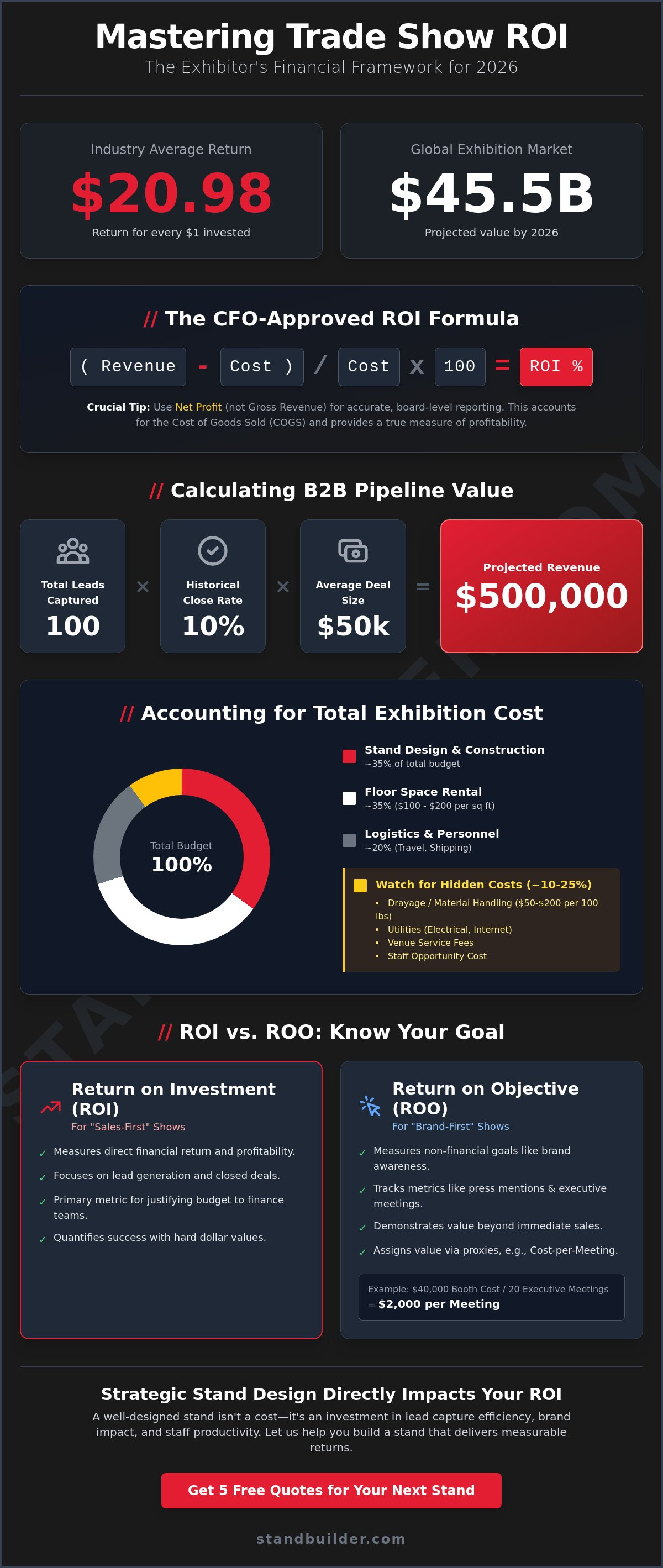
For every dollar your company invests in an exhibition, you should expect to see $20.98 in return. However, with the global exhibition industry reaching $45.5 billion in 2026, the pressure to prove that specific return to your board has never been higher. Knowing exactly how to calculate trade show ROI formula is the difference between a successful budget request and a rejected proposal. It's often the only way to justify a custom island exhibit that can cost over $250,000.
You likely find it difficult to attribute long-cycle B2B sales to a single event or feel frustrated when hidden drayage fees, which can cost up to $200 per hundred pounds, blow out your budget. We understand that quantifying brand awareness and networking value often feels like guesswork. This guide changes that. You'll master the exact formulas and strategic frameworks needed to quantify your exhibition success and justify every dollar of your booth investment. We provide a repeatable ROI formula for your board reports, a comprehensive checklist of exhibition costs, and a reliable way to measure Return on Objective (ROO).
Key Takeaways
- Master the fundamental how to calculate trade show ROI formula using a net profit approach that satisfies CFO-level reporting requirements.
- Identify and account for "invisible" exhibition costs like drayage and venue service fees to prevent budget overruns.
- Learn to quantify Return on Objective (ROO) by tracking leading indicators such as booth dwell time and press mentions.
- Implement a six-month tracking framework that uses rigorous lead-scoring to bridge the gap between event engagement and final sales.
- Discover how strategic stand design and conversion paths can directly increase your lead capture efficiency and staff productivity.
The Fundamental Trade Show ROI Formula
To understand your exhibition's financial impact, you must use a standardized Return on Investment (ROI) calculation. The most effective how to calculate trade show ROI formula follows this structure: [(Total Revenue from Show - Total Cost of Show) / Total Cost of Show] x 100. While this equation appears simple, its accuracy depends on whether you use gross revenue or net profit. For CFO-level reporting, always use net profit. It accounts for the cost of goods sold (COGS), providing a realistic view of the event's contribution to the bottom line. Gross revenue often inflates success, hiding the true cost of fulfillment and logistics.
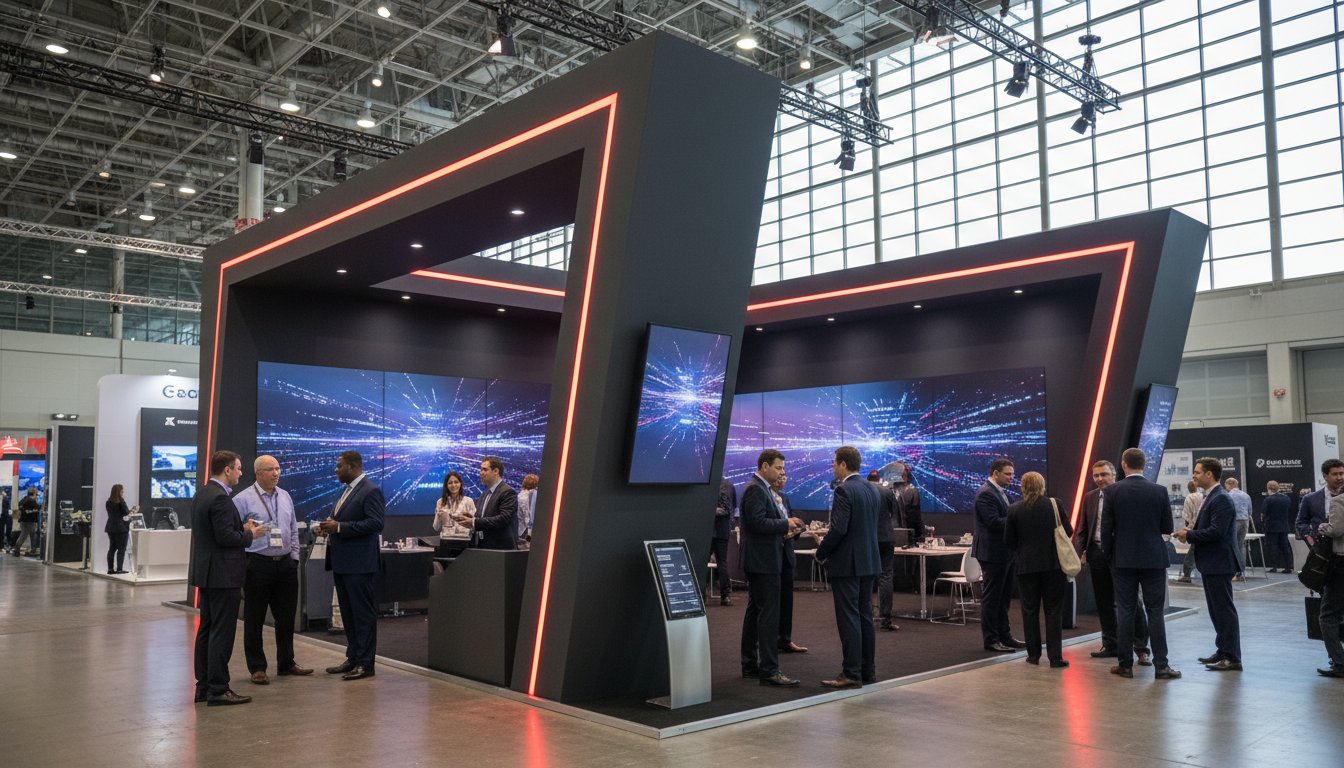
In the current 2026 landscape, the average return is $20.98 for every $1 invested. This benchmark serves as a critical KPI for your marketing team. If your calculation falls significantly below this figure, it's time to audit your logistics, booth location, or stand design. High-performing companies don't just guess; they use this how to calculate trade show ROI formula to justify a custom island exhibit that might cost over $250,000. They treat the exhibition floor as a high-yield investment vehicle rather than a simple branding exercise.
Defining Total Revenue in a B2B Context
B2B sales cycles are rarely completed on the show floor. Since 81% of attendees have buying authority, the value you capture is often tied to future contracts. To calculate "Estimated Value" for leads in the pipeline, multiply your total lead count by your historical close rate and average deal size. If you typically close 10% of leads and your average deal is $50,000, then 100 leads represent $500,000 in projected revenue. Pipeline Value is the primary metric for long-cycle B2B exhibitors. This approach allows you to report success to stakeholders immediately after the event ends, rather than waiting eighteen months for a contract to sign.
ROI vs. ROO: When to Use Which
Not every event is a "Sales-First" show. Some industry summits are "Brand-First" opportunities where the goal is positioning rather than immediate lead capture. In these cases, you should track Return on Objective (ROO). Assign a dollar value to these objectives by calculating the cost-per-meeting. If a 20x20 modular booth costs $40,000 and you host 20 high-level executive meetings, each meeting costs $2,000. Compare this to the travel and time costs of flying sales reps to individual client offices. This comparison demonstrates the efficiency of the trade show environment, balancing short-term wins with long-term brand equity.
Accounting for the Total Cost of Exhibition
A precise how to calculate trade show ROI formula is only as reliable as the data you feed into it. Most exhibitors fail because they underestimate ancillary expenses, which typically account for 15% to 25% of the total budget. To build a CFO-ready report, you must categorize your spending into the "Big Three": floor space rental, stand design and construction, and logistics. In 2026, floor space typically costs between $100 and $200 per square foot, often representing 30% to 40% of your total investment. A general rule of thumb is to estimate your total spend at three to five times the cost of the floor space rental.
Hidden costs often erode your margins if left unmonitored. When calculating hard metrics for trade show ROI, your "Total Cost" must include drayage, which ranges from $50 to $200 per hundred pounds. Utilities like electrical and internet hookups add another $500 to $2,000. Don't forget personnel expenses. Flights and hotels cost between $500 and $1,500 per person, and the opportunity cost of your staff's time away from the office is a real financial factor. You should also account for pre-show marketing and post-show lead nurturing campaigns to ensure the how to calculate trade show ROI formula reflects the full scope of the project.
Custom Stand Fabrication and Lifecycle Costs
Investing in a custom exhibition stand design provides a high-impact presence, but the initial $100 to $200 per square foot cost should be amortized over its expected lifecycle. If you plan to use the structure for three years, divide the fabrication cost by the total number of shows to lower your per-event expense. Compare this to modular rentals, which can offer 40% to 60% savings for one-off events. To find the most cost-effective solution for your specific schedule, you can request five free quotes from our global network of contractors.
International Logistics and On-site Management
International exhibiting introduces complexities like customs documentation, freight forwarding, and local labor regulations. In many regions, specific union rules dictate installation and dismantling (I&D) costs, which can vary significantly by city. Secure warehousing between shows is another essential line item for multi-show tours. Always include a 10% contingency buffer in your logistics budget to handle unexpected venue service fees or shipping delays. This ensures your final ROI calculation remains accurate even when international variables shift.
Measuring Return on Objective (ROO) for Brand Impact
While the hard financial how to calculate trade show ROI formula is essential for the board, it often misses the strategic "halo effect" of a major exhibition. Brand awareness isn't fluff; it's a leading indicator of future revenue. In 2026, 64% of trade show attendees are not current customers of the exhibitors they visit. This represents a massive opportunity for market expansion that standard sales attribution might overlook. By understanding Return on Objective (ROO), you can quantify these non-transactional wins and justify the broader marketing spend.
Track booth dwell time as a primary indicator of engagement. The average attendee spends 5.5 hours visiting exhibits across the entire event. If your booth captures a significant portion of that time, you're winning the battle for mindshare against your direct competitors. You should also assign a dollar value to competitive intelligence. Gathering data on ten competitors in three days would normally require weeks of independent research. Assigning a "researcher day-rate" to this activity helps round out the value proposition of your presence. It turns the show floor into a strategic intelligence hub.
Quantifying Brand Equity and Awareness
Use digital triggers like QR codes or NFC tags to turn passive visitors into trackable data points. This allows you to measure "Media Value Equivalent" by comparing your event reach to the cost of equivalent digital advertising. High-impact trade show backdrops and immersive tech like AR/VR drive organic social shares, which amplify your brand far beyond the venue walls. If your booth generates 100 organic LinkedIn posts, calculate the cost of the impressions those posts would have required through paid channels to find your earned media value.
Strategic Networking and Relationship Value
Face-to-face time with Tier-1 clients is a major efficiency gain. Use the "Meeting Value" formula: multiply the number of confirmed executive meetings by the average cost of a traditional field sales call, which is currently $259. If you host 40 meetings, that's $10,360 in saved sales travel costs. This consolidation is a powerful argument for your how to calculate trade show ROI formula. Additionally, track "Customer Retention Value" by noting which existing clients visited the stand. Since retaining a client is significantly cheaper than acquiring a new one, these interactions provide a high-value safeguard for your current revenue streams.
A Step-by-Step Framework for ROI Tracking
Execution is where most exhibitors lose visibility on their spending. To accurately apply the how to calculate trade show ROI formula, you need a structured data collection process that starts months before the doors open. Without a baseline, your final numbers lack context. You can't determine if a $112 cost per lead is a success unless you know your historical benchmarks for other channels like field sales, which averages $259 per call. Follow these five steps to ensure your data is audit-ready.
- Step 1: Baseline Setting. Establish your KPIs at least 6 months before the event. Define what a "win" looks like for this specific show.
- Step 2: Rigorous Lead Scoring. Implement a Hot, Warm, and Cold scoring system. Since 81% of attendees have buying authority, you must prioritize those ready to purchase within the next quarter.
- Step 3: Real-Time Capture. Use integrated CRM tools and badge scanning. Don't rely on business cards. Digital retrieval ensures no lead is lost in the post-show chaos.
- Step 4: Post-Mortem Audit. Compare every actual invoice against your projected budget. This includes the "invisible costs" like drayage and electrical fees discussed earlier.
- Step 5: Revenue Reconciliation. Perform a reconciliation at 6 and 12 months. B2B sales take time, and your ROI will likely grow as the pipeline matures.
Pre-Show Preparation: Setting the Baseline
Success requires alignment between your sales and marketing teams. Train your booth staff on specific data entry protocols to ensure the information fed into your how to calculate trade show ROI formula is clean and actionable. If your team doesn't understand the difference between a "Hot" lead and a "Warm" inquiry, your post-show projections will be skewed. Establish clear follow-up timelines before the show starts. A lead that isn't contacted within 48 hours loses value quickly, directly impacting your final return. To streamline your planning and reduce costs, you can compare five free quotes from local contractors who understand venue-specific requirements.
Post-Show Analysis: The Reconciliation Phase
Attribution is the biggest challenge in B2B exhibiting. If a client visited your stand but didn't sign until six months later after seeing three retargeting ads, how do you credit the show? Use a multi-touch attribution model that assigns a percentage of the deal value to the exhibition. Calculate your Customer Acquisition Cost (CAC) specifically for this channel by dividing the total show cost by the number of new customers won. Present your findings to the CFO using language they respect. Focus on net profit margins, pipeline velocity, and the long-term lifetime value of the accounts secured at the event.
Maximising ROI through Strategic Stand Design
Strategic architecture is the final variable in the how to calculate trade show ROI formula that most exhibitors overlook. While previous sections focused on data collection and cost accounting, the physical environment dictates how effectively your team captures that data. A poorly designed layout creates friction, forcing staff to navigate obstacles rather than engaging with the 81% of attendees who possess buying authority. By contrast, a conversion-oriented design treats the booth as a high-performance machine where every square foot is optimized to move visitors from initial curiosity to a qualified meeting. Standbuilder International focuses on this intersection of aesthetics and operational flow to ensure your physical presence supports your financial targets.
The "Wow Factor" should never come at the expense of utility. While a custom island exhibit can cost over $250,000, its value lies in its ability to facilitate demos and meetings. High-impact aesthetics draw people in, but functional zones ensure they stay long enough to enter your sales funnel. Balancing these elements is key to maintaining a healthy return on your investment. Standbuilder International helps you achieve this balance by connecting you with experts who prioritize both visual impact and operational flow.
Functional Design as a Revenue Driver
Your booth must act as a filter. Prioritize high-value interactions by allocating space for semi-private zones where technical discussions can happen away from the noise. This prevents the loss of Tier-1 leads who might otherwise be overwhelmed by the crowd. You can also integrate AV technology to handle basic product walkthroughs, allowing your senior staff to focus on deeper qualifying questions. Your graphics must communicate your unique selling proposition (USP) in under 3 seconds. If an attendee cannot understand what you do while walking past, you've lost a potential data point for your ROI calculation.
Optimising for Logistics and Operational Efficiency
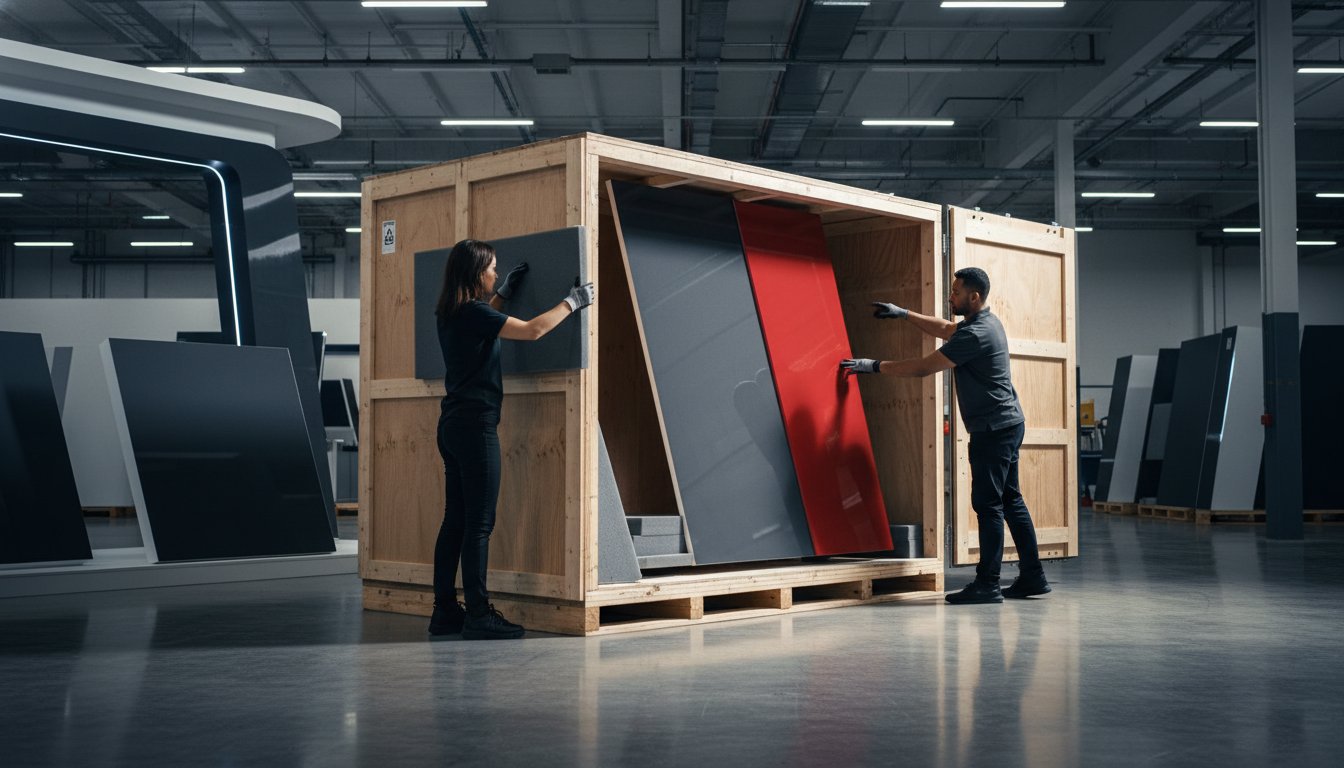
Operational efficiency starts on the drawing board. Designing with modular components that pack into standard crates can significantly reduce the freight volume and warehousing costs that often bloat budgets. Using lightweight materials also lowers drayage fees, which can reach $200 per hundred pounds at major venues. By partnering with a specialized international exhibition stand contractor, you gain access to local labor pools and regional storage. Standbuilder International leverages these local networks to eliminate cross-border shipping risks and ensure your installation and dismantling costs remain fixed and predictable.
Securing Your Competitive Advantage in 2026
Mastering these metrics is no longer optional. Moving beyond simple lead counts to a robust financial model ensures every exhibition choice is defensible. By integrating the how to calculate trade show ROI formula into your standard operating procedures, you transition from viewing events as an expense to seeing them as high-yield growth engines. This data-driven approach allows your marketing team to scale what works and cut what doesn't with surgical precision. It's about ensuring that every square foot of your booth translates into measurable pipeline velocity.
Standbuilder International provides the global infrastructure needed to execute these strategies across any border. Through our partnership with CBS Neospace and our established hubs in Atlanta and Germany, we specialize in building high-ROI custom environments while minimizing the logistics costs that often erode profit margins. Our network simplifies the complexities of international procurement, allowing you to focus on lead conversion rather than freight documentation. Request a Free Consultation to Optimise Your 2026 Trade Show ROI and let us help you turn your next exhibition into a measurable financial victory. Success in the competitive landscape of 2026 belongs to those who measure what matters.
Frequently Asked Questions
What is a good ROI for a trade show in 2026?
A good benchmark for 2026 is a return of $20.98 for every $1 spent on the exhibition. This figure represents the current industry average for successful B2B exhibitors. While your specific return depends on your industry and deal size, aim to exceed this baseline by optimizing your booth location and lead follow-up speed.
How do you calculate ROI if the sales cycle is longer than a year?
Use the Pipeline Value metric to project your return immediately after the show. Multiply the number of qualified leads by your historical close rate and average contract value. This provides a data-backed estimate for your board reports while you wait for final revenue reconciliation at the 12-month or 18-month mark.
Should I include staff salaries in my trade show cost calculation?
Yes, you must include the opportunity cost of your staff's time along with their direct expenses. Account for flights, hotels ranging from $500 to $1,500 per person, and daily per diems between $75 and $150. Including these figures ensures your final calculation reflects the true total cost of the exhibition.
What is the difference between ROI and ROO?
ROI measures the direct financial profit using the how to calculate trade show ROI formula. ROO, or Return on Objective, tracks non-financial strategic goals like media mentions or executive networking. Use ROI to prove bottom-line impact and ROO to demonstrate the long-term value of brand positioning and competitive intelligence.
How do I measure brand awareness at a trade show?
Track digital engagement metrics such as QR code scans, NFC tag interactions, and social media mentions generated during the event. You should also measure booth dwell time, as the average attendee spends 5.5 hours visiting exhibits. Compare these engagement levels to the cost of equivalent digital advertising to find your earned media value.
Is booth rental or custom construction better for ROI?
Modular and rental packages offer 40% to 60% savings for one-off events or companies testing new markets. However, custom construction often delivers a higher ROI over a three-year period when you amortize the fabrication costs across multiple shows. Choose rental for flexibility and custom builds for high-impact, long-term brand consistency.
How can I lower my trade show costs without sacrificing lead quality?
Hire local contractors through a global network to eliminate expensive international freight and customs documentation. You can also use lightweight modular components to reduce drayage fees, which often range from $50 to $200 per hundred pounds. Prioritize smaller, niche events that offer lower floor space costs but higher concentrations of Tier-1 buyers.
What tools are best for tracking trade show leads and conversion?
Use badge scanners and lead retrieval apps that integrate directly with your CRM, such as Salesforce or HubSpot. These tools allow your team to score leads as Hot, Warm, or Cold in real-time. Digital capture prevents data loss and ensures your how to calculate trade show ROI formula is based on accurate, verified lead counts.