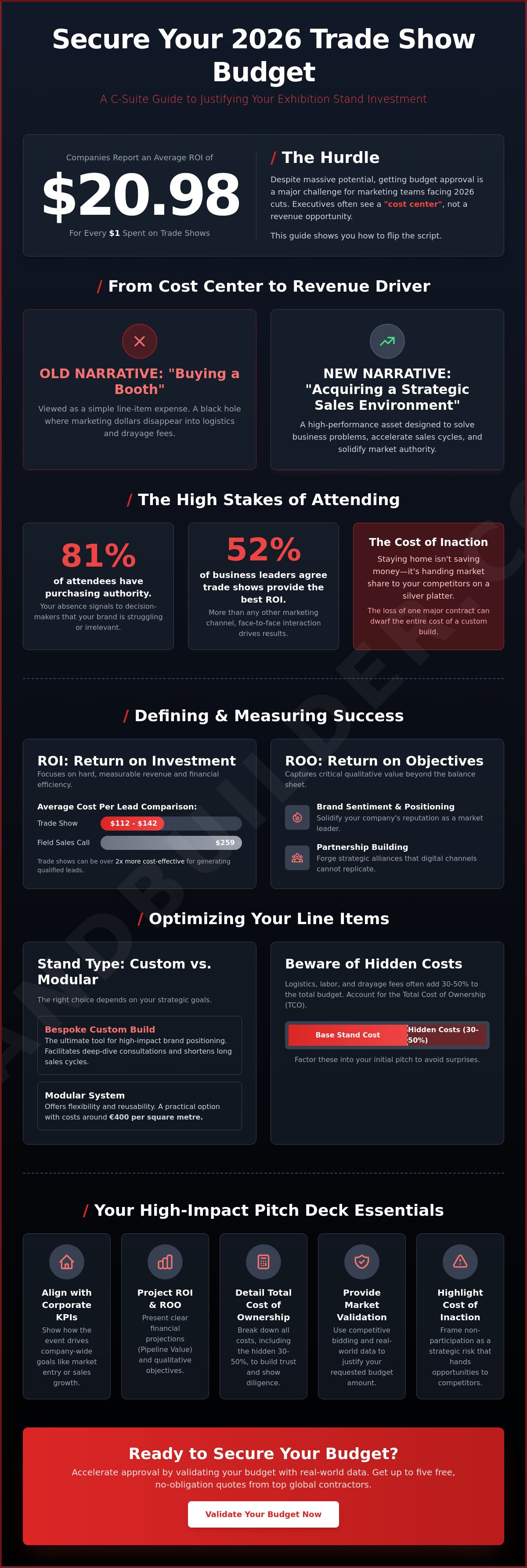
Did you know that companies are currently reporting an average ROI of $20.98 for every $1 spent on trade shows? Despite this massive potential, getting budget approval for exhibition stand projects remains a stressful hurdle for marketing teams facing 2026 budget cuts. You likely feel the pressure to justify every cent, especially when exhibiting in high-cost hubs like Las Vegas can start at $10,000 for a basic 10x10 rental before labor and drayage fees are even added. It's frustrating to know that 81% of attendees have purchasing authority while your board only sees a "cost center" on a spreadsheet.
You can flip this script by shifting the narrative from "buying a booth" to "acquiring a strategic sales environment." This guide will show you how to master the business case to turn your exhibition stand into a revenue driver that executives can't refuse. We'll provide a clear framework for reporting success post-show and help you account for those hidden logistics costs that often add 30% to 50% to a total budget. From selecting a global contractor to comparing a €400 per square metre modular system against a bespoke custom build, you'll gain the confidence to secure the investment your brand deserves.
Key Takeaways
- Learn to reframe your exhibition presence as a strategic revenue driver rather than a line-item expense to win executive support.
- Master the distinction between Return on Investment (ROI) and Return on Objectives (ROO) to prove both financial and qualitative value.
- Simplify getting budget approval for exhibition stand projects by breaking down the Total Cost of Ownership (TCO) for custom and modular systems.
- Discover the essential slides for a high-impact pitch deck that aligns your 2026 trade show goals with corporate objectives.
- Leverage competitive bidding and market validation to justify your requested budget using real-world data and five free quotes.
Framing Exhibition Costs as Strategic Investments
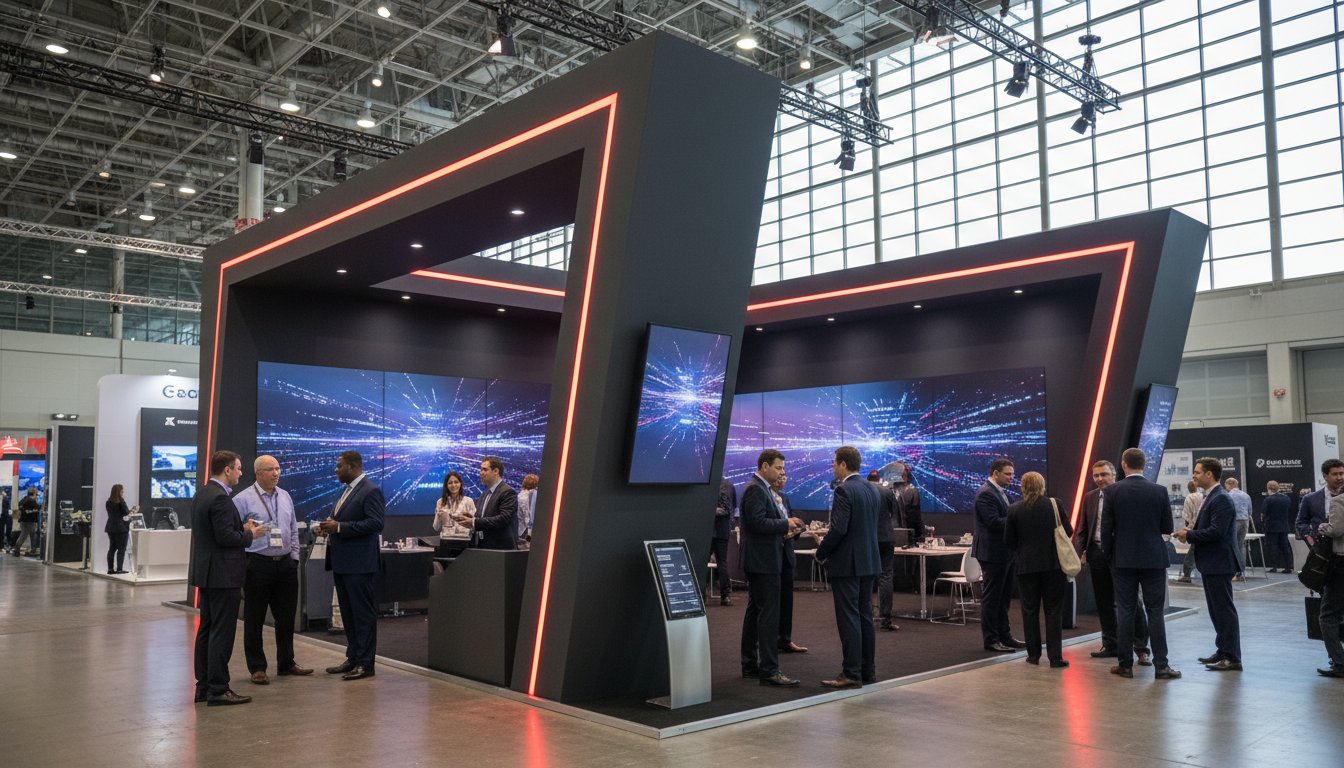
Securing a signature for a major trade show spend often feels like an uphill battle. Most finance departments view your request as a "cost center," which is a black hole where marketing dollars disappear into logistics and drayage. To succeed in getting budget approval for exhibition stand projects in 2026, you must flip this narrative. You aren't simply buying a booth. You're building a high-performance sales environment designed to solve specific business problems, such as breaking into the European market or launching a new product line to the 1.23 million projected attendees in Las Vegas.
Executives respond to growth, not just brand awareness. When you align your stand design with 2026 corporate KPIs, you transform the conversation. If the company goal is a 15% increase in enterprise contracts, your stand becomes the primary tool for hosting high-level negotiations. Being absent from the hall carries a psychological weight; it signals to the 81% of attendees with purchasing authority that your brand is either struggling or irrelevant. In the fast-paced world of international trade, your physical presence is your most vocal advocate.
Moving Beyond Lead Counting
Relying solely on lead volume is a trap. While a small modular booth might generate 50 scans, a bespoke exhibition stand facilitates deep-dive consultations that can shorten an eighteen-month sales cycle by half. High-value custom stands prioritize Strategic Brand Positioning, ensuring your company is seen as a market leader in international halls. A strategic investment in custom exhibition stand design is the deliberate allocation of capital toward a high-impact physical environment designed to accelerate sales cycles and solidify market authority. This approach moves the needle on getting budget approval for exhibition stand builds because it focuses on quality over quantity.
The Cost of Inaction (COI)
The most dangerous line item in your budget is the one you don't include: the cost of staying home. When your competitors exhibit and you don't, you aren't just saving money; you're actively handing over market share. Research shows companies report an average ROI of $20.98 for every $1 spent on trade shows. A fundamental understanding Return on Investment (ROI) reveals that the loss of a single major contract to a rival can dwarf the entire cost of a custom build. By framing the stand as a tool for accelerated deal-closing, you highlight the missed opportunities of not having a face-to-face sales environment. If 52% of business leaders believe trade shows provide the greatest ROI compared to other channels, then skipping the show is a calculated risk that rarely pays off.
Defining Success Metrics: ROI vs. ROO
To succeed in getting budget approval for exhibition stand investments, you must provide the C-suite with more than just a list of scanned badges. In 2026, sophisticated exhibitors use heat mapping and RFID tracking to measure "Exhibit Efficiency," identifying exactly which zones of the stand drove the highest engagement. This data allows you to generate ROI from trade shows by proving that your physical presence is a measurable data point in the customer journey. While ROI focuses on the hard revenue, Return on Objectives (ROO) captures brand sentiment and the value of partnership building, which are critical for long-term market authority.
Integrating digital touchpoints into your physical stand metrics provides a holistic view of performance. When an attendee interacts with an AV rental display or downloads a brochure via a QR code, you're capturing intent data that digital channels often miss. These interactions are the foundation of a robust business case. If you're ready to see how different configurations impact these metrics, you can compare specialized contractors who focus on data-driven booth layouts.
Calculating the Financial ROI
The average cost per lead at a trade show currently sits between $112 and $142. Compare this to the $259 typically required for a traditional field sales call. When you present these figures, the business case becomes clear. You can calculate your "Pipeline Value" by multiplying the number of qualified leads by your average deal size and close rate. Linking this financial logic to a high-impact custom exhibition stand design ensures that every square metre is optimized for conversion. This design-driven ROI proves that aesthetics and analytics work together to drive the bottom line.
The Sustainability Dividend (ESG ROI)
Sustainability is no longer a "nice to have" in 2026 corporate reporting; it's a financial lever. Modular stand systems often offer 40% to 60% cost savings over multiple shows compared to one-off custom builds, primarily by reducing long-term storage and disposal fees. By tracking the carbon footprint of your international logistics, you provide the finance team with a significant ESG (Environmental, Social, and Governance) dividend. This turns a high initial fabrication fee into a multi-year PR win and a lower total cost of ownership. Proving that your stand is both a revenue driver and an eco-friendly asset makes getting budget approval for exhibition stand projects significantly smoother.
Optimizing the Line Items: Custom vs. Modular Value
Winning the argument for getting budget approval for exhibition stand projects requires transparency about the Total Cost of Ownership (TCO). It's a mistake to focus only on the fabrication quote. You need to account for the "hidden" layer of expenses that frequently inflate final invoices. According to industry data from March 2026, costs like drayage, electrical services, and labor can add 30% to 50% to your initial budget. By presenting a fully loaded TCO, you demonstrate fiscal responsibility and prevent the "emergency" requests that frustrate finance teams.
To optimize your spend, consider these primary line items:
- Fabrication and materials
- Freight and international shipping
- Venue drayage (material handling)
- Electrical, AV, and technical rigging
- Installation and Dismantle (I&D) labor
Custom Bespoke vs. Modular Systems
Your choice between custom and modular systems should align with your 2026 show calendar. Custom-built stands, which can range from €400 to over €1,000 per square metre in Europe, are the gold standard for high-stakes product launches. They provide the brand differentiation needed to dominate a hall. These builds often utilize high-impact trade show backdrops to create immersive environments that stop traffic. Conversely, modular systems offer 40% to 60% savings for brands exhibiting multiple times a year. They're efficient, reusable, and significantly reduce storage fees.
The International Logistics Factor
For US firms, the "shipping from Atlanta" model is a budget killer. Shipping a 20x20 exhibit across the Atlantic can cost more than the booth itself once you factor in customs and port delays. Standbuilder's partnership with CBS Neospace allows you to design in the US but fabricate locally in European hubs like Ratingen. This "Messebauer" approach ensures you're navigating local venue regulations without paying international freight premiums.
This local expertise is vital for Measuring Event Impact accurately. Professional project management prevents the budget overruns that occur when teams don't understand local union labor rules. By using a global contractor network, you're not just getting budget approval for exhibition stand builds; you're securing a predictable, risk-mitigated path to a successful show. It's about being efficient with capital while maintaining a high-standard marketplace presence.
Constructing the Budget Approval Pitch Deck
Your pitch deck is the final filter between a marketing concept and a signed contract. It must translate creative ambition into the cold financial logic that executives demand. While previous sections focused on the "why," this deck is about the "how" and the "how much." A successful presentation for getting budget approval for exhibition stand projects replaces uncertainty with transparency. You need to present a narrative where the stand isn't a drain on resources but a high-performance engine for the company's 2026 growth targets.
A high-impact deck should follow a logical, four-part structure:
- Executive Summary: Lead with the headline. Remind the board that trade shows offer an average ROI of $20.98 for every $1 spent. This 30-second elevator pitch frames the entire request as a profit-seeking venture.
- The Strategic Alignment Slide: Explicitly link the show to the company’s 2026 goals. If the goal is a 10% increase in European market share, show how a presence at a major German "Messe" facilitates that specific outcome.
- The Design Preview: Shift from numbers to reality. Use 3D conceptualization to build emotional buy-in. It's much harder to cut a budget when the board can see the physical environment where deals will be closed.
- The Financial Breakdown: List everything. Include fabrication, AV rentals, and those 30% to 50% hidden fees like drayage. Transparency acts as a trust-builder and prevents "sticker shock" later in the process.
Visualizing Success with 3D Design
3D renderings bridge the gap between "expense" and "reality." They allow you to demonstrate "Traffic Flow" and engagement zones, proving that every square metre has a purpose. You can show exactly where high-value consultations happen and how the stand layout drives attendees toward your sales team. Requesting a free 3D design from Standbuilder provides a high-fidelity visual asset that transforms a spreadsheet line item into a tangible business opportunity for your stakeholders. This visual evidence makes it difficult for decision-makers to argue that the stand is just "decoration."
Addressing the CFO’s Objections
CFOs often ask, "Can we go smaller?" Pre-empt this by using data-backed footprint analysis. Explain that while a 10x10 rental in Las Vegas starts at $10,000, a 20x20 island starting at $18,000 provides four times the visibility and engagement potential. You should also justify the professional project management fee as an insurance policy. It protects the company against venue fines and union labor overruns that can spiral out of control. Emphasize the "Fixed-Price" guarantee offered by many in our contractor network to eliminate the fear of variable costs. To start building your data-backed case, request your five free quotes today and get instant market validation for your budget.
Accelerating Approval with Standbuilder’s Competitive Bidding
The final step in getting budget approval for exhibition stand projects is proving that your requested figures represent the best possible market value. Procurement departments and CFOs rarely approve "single-source" requests without scrutiny. By utilizing Standbuilder’s competitive bidding model, you provide instant market validation. Presenting five distinct, vetted quotes demonstrates that you've conducted thorough due diligence. It shifts the perception of your budget from a subjective estimate to a verified market reality based on current 2026 pricing trends.
Efficiency is the hallmark of a professional business case. Our platform simplifies the procurement process by allowing you to compare "apples-to-apples" proposals from a global contractor network. This transparency eliminates the friction of manual outreach and ensures that every technical requirement, from AV rentals to double-decker structural engineering, is accounted for in the initial RFP. With the global trade show market projected to reach up to $51.3 billion in 2026, standing out requires a partner who understands the scale of international competition.
The Power of Choice
Presenting multiple quotes isn't just about finding the lowest price; it's about finding the right fit for your strategic goals. Standbuilder’s network allows you to evaluate different creative approaches side-by-side. You can compare a high-impact bespoke build against a cost-effective modular system, providing your board with a range of investment levels. The benefit of "no-obligation" 3D designs means you can visualize these options during the early-stage planning phase. This prevents the project from stalling due to a lack of visual clarity or budget uncertainty.
Global Expertise, Local Execution
Managing an international show from a US headquarters introduces significant logistical risk. Standbuilder provides the peace of mind of a US-based partner while leveraging local execution hubs in cities like Atlanta and Ratingen. Our partnership with CBS Neospace ensures that your project meets rigorous German "Messebau" quality standards without the need for expensive trans-Atlantic shipping. Technical engineering plays a massive role here; by optimizing the build for local materials and labor rules, we reduce fabrication waste and lower your total footprint.
This localized approach ensures global consistency for your brand while respecting the specific regulations of venues in Europe or North America. It’s the final piece of your business case: a risk-mitigated, data-backed plan that aligns with corporate sustainability and financial targets. Don't leave your 2026 success to chance. Get your 5 free quotes and 3D design today to start your budget approval process and turn your vision into a high-performing reality.
Secure Your 2026 Exhibition Success
Winning in 2026 requires more than a presence; it demands a strategic sales environment that justifies every marketing dollar. You now have the framework to reframe costs as investments and the tools to prove that physical presence is a measurable revenue driver. By prioritizing transparency and using competitive bidding, getting budget approval for exhibition stand projects becomes a logical step in your company's growth plan rather than a financial hurdle. It's about moving from a state of uncertainty to a state of confident decision-making.
Standbuilder acts as your expert facilitator throughout this process. Our Atlanta-based project management team provides global reach, while our strategic partnership with CBS Neospace GmbH ensures German-engineered quality for your European shows. We combine Red Dot-level design expertise with a streamlined procurement process to help you find the perfect match. Don't let your 2026 goals be sidelined by budget cuts. You have the business case; now you need the partner to execute it.
Request 5 Free Quotes & a Custom 3D Design for Your 2026 Exhibition and secure the investment your brand deserves. You're ready to lead the hall with a stand that performs as well as it looks.
Frequently Asked Questions
How far in advance should I start the budget approval process for an exhibition stand?
Start the process at least nine to twelve months before the show date. This lead time allows you to secure prime floor space and negotiate better rates with contractors before their schedules fill up. Early planning is essential for getting budget approval for exhibition stand projects because it provides a clear, data-backed roadmap for the finance department.
What are the most common "hidden costs" in a trade show budget?
The most frequent hidden costs are drayage (material handling), electrical rigging, and union labor fees. According to industry reports from January 2026, these expenses often add 30% to 50% to your initial booth fabrication quote. Always include a contingency line item in your pitch deck to prevent unexpected budget overruns during the show.
Is it better to rent or buy an exhibition stand for a 2026 show?
Renting is often the superior choice for 2026 shows due to its 40% to 60% cost savings compared to purchasing. Rental exhibits provide the flexibility to scale your presence based on the specific event's requirements. If you exhibit at fewer than three shows per year, renting a modular or custom system is usually more fiscally responsible.
How do I calculate the ROI of a custom exhibition stand?
Calculate ROI by taking the total pipeline value generated and dividing it by the total cost of the exhibit. With companies reporting an average ROI of $20.98 for every $1 spent, you should focus on the quality of leads. Use a formula that multiplies your qualified leads by your close rate and average deal size to show the hard revenue potential.
What is the difference between a modular and a custom stand in terms of budget?
Modular stands in Europe typically range from €250 to €450 per square metre, while custom-built stands start at €400 and can exceed €1,000 per square metre. Modular systems are ideal for high-frequency calendars and smaller footprints. Custom stands are better suited for high-stakes brand dominance where unique architecture is required to stop traffic in a crowded hall.
Can I get a 3D design for my booth before my budget is officially approved?
Yes, you can receive a professional 3D design before your budget is officially signed off. Standbuilder provides free, no-obligation 3D designs to help you visualize the environment for your stakeholders. This visual asset is often the deciding factor in getting budget approval for exhibition stand requests because it bridges the gap between a spreadsheet and reality.
How does exhibiting in Europe differ from the US in terms of cost structure?
US shows are heavily influenced by mandatory union labor and drayage fees, which can make a 10x10 rental in Las Vegas start at $10,000 before services. In Europe, the "Messebau" model is more common, providing a more inclusive package that covers fabrication and basic floor services. Understanding these regional differences prevents "sticker shock" during your international expansion.
What metrics do CFOs care about most when reviewing an exhibition budget?
CFOs prioritize Cost Per Lead (CPL) and Pipeline Velocity above simple brand awareness. They want to see that the average CPL at the show, currently between $112 and $142, is significantly lower than traditional field sales calls at $259. Highlighting the sustainability dividend and ESG compliance also carries significant weight in 2026 corporate reporting.