Did you know that since February 24, 2026, a temporary 10% import duty has applied to nearly all articles entering the United States under Section 122 of the Trade Act? You’ve spent months perfecting your 3D design and selecting the ideal modular booth, so the last thing you need is your materials stuck in a customs warehouse while the show floor opens. Successfully managing exhibition freight and customs is no longer just a shipping task; it’s a critical project management milestone that starts during your initial design phase.
We understand the frustration of hidden drayage fees and the complexity of international paperwork that can quickly derail a global tour. You deserve a predictable logistics budget and a seamless cross-border transit process for your bespoke stands. This article teaches you how to navigate the 2026 landscape, from managing ATA Carnet processing fees that now range from $255 to $545 to securing your 40% security deposit. You’ll get a clear timeline for document submission and expert strategies to handle current ocean freight volatility, ensuring your brand makes an impact without the stress of unexpected delays or hidden costs.
Key Takeaways
- Learn why treating logistics as a project milestone rather than a shipping task is essential to protecting your exhibition ROI.
- Discover how to use ATA Carnets as a duty-free passport for your goods to navigate over 80 countries without unexpected tax burdens.
- Master the 24-week countdown for managing exhibition freight and customs to ensure your bespoke stand arrives at the venue on schedule.
- Compare the cost-efficiency of independent freight forwarders against official show carriers to avoid hidden drayage and handling fees.
- See how integrating logistics into the initial 3D design phase simplifies cross-border transit for modular and double-decker stands.
Why Managing Exhibition Freight and Customs is a Strategic Necessity
Success at an international trade show depends on more than just a great 3D design or a skilled sales team. If your booth materials are stuck in a port or delayed at a loading dock, you face a 100% loss of your exhibition ROI. You aren't just paying for shipping; you're investing in the certain arrival of your brand's physical presence. Managing exhibition freight and customs requires a shift in perspective. You must view logistics as a core project management milestone that begins months before the show floor opens.
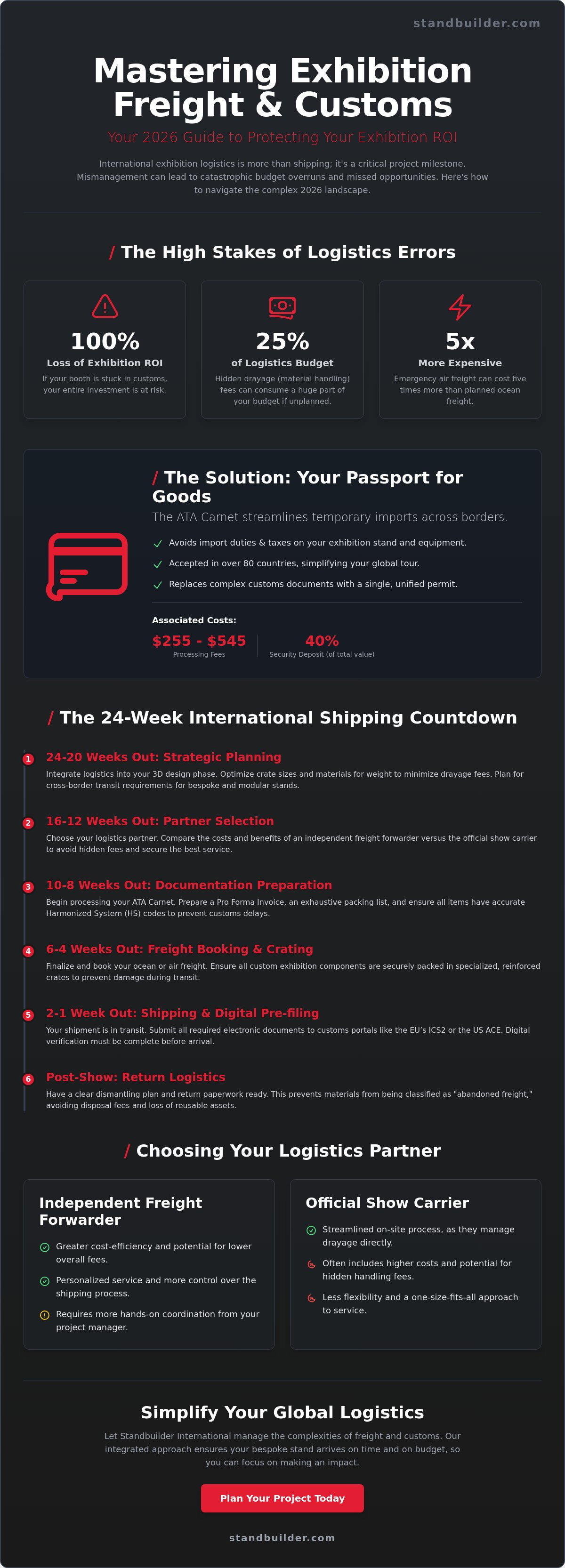
Standard parcel shipping differs significantly from trade show freight. While a typical carrier might deliver to a front desk or a loading bay, exhibition logistics involve the complex "Last Mile" at convention centers. This includes navigating the marshaling yard and coordinating with the official show contractor for drayage. Drayage, or material handling, is the process of moving your crates from the loading dock to your specific booth space. It's often billed by weight, and failing to account for these fees can consume up to 25% of your total logistics budget if your crates aren't optimized for weight and size.
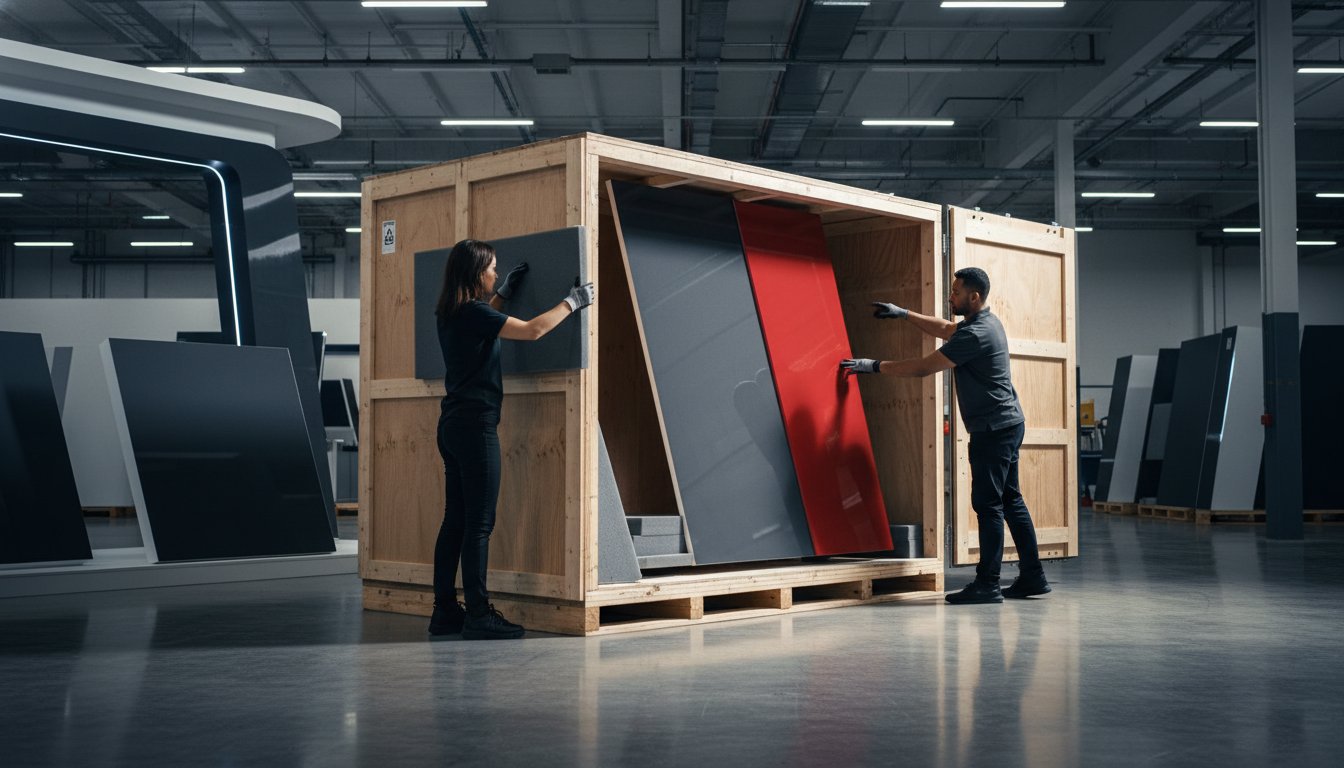
Custom exhibition stands demand even higher levels of coordination. Unlike modular kits that fit into standard cases, bespoke stands often feature fragile architectural components and high-value AV rentals. These require specialized crating and professional handling to prevent damage during cross-border transit. Utilizing tools like an ATA Carnet helps streamline this process by serving as a passport for your goods, but it requires precise documentation to avoid costly hold-ups at the border.
The Financial Impact of Logistics Errors
Logistics mistakes carry a heavy price tag. Emergency air freight can cost five times as much as ocean freight, and last-minute on-site furniture rentals often come with a 30% surcharge over pre-show rates. If your shipment misses its assigned installation window, you might also face double-time labor charges for late-night booth assembly. The true cost of delay is the sum of lost lead generation opportunities, wasted travel expenses for your team, and the irreversible damage to your brand’s reputation in a competitive international market.
Bespoke Stands and Fragility
Your custom exhibition stand design dictates your entire packing strategy. Heavy double-decker stands or intricate country pavilions need reinforced, custom-built crates that protect delicate finishes and integrated technology. Planning for the return journey is just as vital as the arrival. You must ensure your freight forwarder has a clear dismantling plan and the necessary paperwork ready the moment the show ends. This prevents your materials from being designated as abandoned freight, which can lead to significant disposal fees and the loss of your reusable assets.
Navigating International Customs: ATA Carnets and Beyond
The ATA Carnet remains the gold standard for temporary imports, acting as a "passport for goods" in more than 80 countries. It allows you to move equipment and stand components across borders without paying duties or taxes. For detailed compliance steps, refer to the U.S. government guidance on ATA Carnets to ensure your documentation is airtight. If you're exhibiting in a country that doesn't accept Carnets, a Temporary Importation Bond (TIB) is the alternative; however, it often requires more complex coordination with a local customs broker.
2026 marks a major shift toward fully digital customs. Major trade hubs now require electronic pre-filing through systems like the EU’s ICS2 Release 3 or the updated US Automated Commercial Environment (ACE) portal. Paper documents are no longer enough. Your data must be uploaded and verified before your freight even leaves the port. When managing exhibition freight and customs, accurate Harmonized System (HS) codes are critical. Misclassifying a modular booth as "permanent furniture" instead of "temporary exhibition material" can lead to immediate border seizures or the 10% ad valorem duty currently in effect for US imports.
Essential Documentation for 2026
Your documentation must be precise to pass automated digital screenings. Use a Pro Forma invoice for exhibition goods rather than a Commercial Invoice, as the latter implies a permanent sale. Your packing list must be exhaustive. Instead of labeling a crate "Booth Parts," list every item, including its weight, serial number, and HS code. In US-EU trade routes, a Certificate of Origin is now frequently scrutinized to verify duty exemptions under current trade agreements. Planning your bespoke stand with a partner who understands these digital requirements ensures your project stays on track.
Avoiding Common Customs Pitfalls
A common error involves mixing "consumables" with Carnet items. Brochures, giveaways, and lead-generation chocolates cannot be listed on an ATA Carnet because they aren't intended to return home. These must be shipped separately with duties paid upfront. Additionally, ensure all wooden crates meet ISPM 15 heat-treatment standards to avoid quarantine. By 2026, digital pre-filing is mandatory in all major trade hubs, meaning any discrepancy between your digital manifest and physical cargo will cause immediate delays. Successfully managing exhibition freight and customs depends on this early digital alignment.
Choosing Your Partner: Freight Forwarders vs. Official Show Carriers
Selecting the right logistics partner is a decision that directly impacts your bottom line and your peace of mind. You generally face two options: the official show carrier or an independent freight forwarder. The official carrier is appointed by the event organizer and enjoys priority access to the loading docks. This convenience often comes at a premium price. While they're efficient for simple shipments, their service can feel impersonal during the high-pressure environment of a major international build. Many exhibitors find that official carriers lack the specialized attention required for high-value assets like double-decker stands or intricate country pavilions.
Independent freight forwarders offer a tailored alternative. These specialists focus exclusively on the events industry and understand that a trade show has no "late" delivery option. When managing exhibition freight and customs, these experts act as your advocate, coordinating every leg of the journey from your warehouse to the booth floor. To ensure you're working with a qualified professional, look for members of the International Exhibition Logistics Association (IELA). This global network sets the industry standards for performance and reliability, ensuring your partner has vetted agents in every major exhibition city from Frankfurt to Las Vegas.
Standard carrier liability is another area where many exhibitors are caught off guard. Most general logistics contracts limit payouts to a few dollars per pound of freight. For a bespoke stand packed with premium AV rentals and custom finishes, this coverage is practically worthless. A specialized exhibition partner provides comprehensive "nail-to-nail" insurance. This covers your materials from the moment they leave your facility, through the transit and show period, until they return to your door. Standbuilder acts as your expert facilitator in this process, connecting you with logistics partners who specialize in these high-stakes requirements.
Vetting a 2026 Logistics Provider
Don't settle for a general freight company. Ask if the provider has a dedicated "Exhibition Desk" staffed by experts who understand venue-specific rules. In 2026, on-site representation is non-negotiable. You need a partner who will be physically present at the convention center to manage the marshaling yard and solve customs discrepancies in real time. Additionally, verify their sustainability credentials. With global trade growth projected at only 2.8% in 2026, leading providers are differentiating themselves through carbon-neutral shipping options and reusable crating solutions.
Understanding Quoting and Contracts
Request "Door-to-Booth" pricing to avoid the shock of hidden fees. A "Port-to-Port" quote might look cheaper initially, but it excludes the critical final steps of managing exhibition freight and customs, such as drayage and venue handling. Ensure your contract clearly defines how "waiting time" surcharges are handled at the marshaling yard. These fees can escalate quickly if your carrier isn't synced with the venue's unloading schedule. Demand a single point of contact who can track your shipment across multi-leg international journeys, providing transparency and accountability at every stage.
The 2026 International Shipping Timeline: A Step-by-Step Countdown
Timing is the most critical factor in successful logistics. A single missed deadline can lead to cascading delays that result in your booth materials arriving after the show has already started. To avoid this, you must treat your shipping schedule with the same rigor as your booth construction. Follow this countdown to keep your project on track:
- 24 Weeks Out: Finalize your custom exhibition stand design and logistics budget. This allows your fabrication team to provide exact crate dimensions for accurate quoting.
- 16 Weeks Out: Select your carrier and apply for your ATA Carnet. This is the ideal time to start managing exhibition freight and customs documentation to account for the mandatory digital pre-filing now required in major trade hubs.
- 8 Weeks Out: Finalize the packing list and schedule the pickup. Ensure every item, from AV equipment to furniture, is documented with its corresponding HS code.
- 4 Weeks Out: Freight departs via ocean. If you are using air or road transit, your departure window is typically two weeks before the move-in date.
- Show Week: Monitor the marshaling yard and confirm final venue delivery with your on-site representative.
Phase 1: Planning and Documentation
Syncing your fabrication schedule with shipping deadlines is essential. If your bespoke stand requires complex structural elements, these must be completed early enough to allow for professional crating. Securing your ATA Carnet and surety bonds at least four months in advance prevents peak-season delays. Remember that the 2026 digital shift means your data must be uploaded to customs portals like the US ACE system well before the physical cargo arrives at the port. Early planning ensures you have time to correct any digital filing errors without risking a border seizure.
Phase 2: Execution and Tracking
In 2026, real-time tracking is a standard requirement for high-value bespoke components. Use IoT sensors to monitor your crates for location and potential impact during transit. Labeling protocols must be strictly followed; every crate needs the show name, booth number, and a 24-hour contact number. If a shipment is flagged at the border, a pre-arranged contingency plan is your only defense. By working with a reliable exhibition stand contractor, you can ensure that even if a primary shipment is delayed, local resources are available to keep your exhibition presence intact. Efficiently managing exhibition freight and customs means being prepared for the unexpected with verified data and a local partner on the ground.
Simplifying Global Logistics with Standbuilder International
Standbuilder doesn't treat logistics as an afterthought. We integrate the complexities of managing exhibition freight and customs directly into our 3D design and fabrication process. This proactive approach ensures that every bespoke stand or modular system is engineered for maximum shipping efficiency. By considering crate dimensions and weight during the initial design phase, we help you minimize drayage costs and avoid the structural overcapacity issues currently affecting the 2026 ocean freight market.
Our strategic partnership between Atlanta, Georgia, and Ratingen, Germany, provides a seamless bridge for US-Europe freight management. This axis allows us to leverage local expertise on a global scale. We coordinate with a vetted network of exhibition stand contractors and logistics specialists who understand the specific nuances of venues in major cities like Frankfurt, Paris, and Las Vegas. You benefit from a streamlined digital workflow that moves you from a state of uncertainty to a state of decision-making with speed and transparency.
The Design-to-Delivery Advantage
We design with shipping efficiency in mind without sacrificing aesthetics. Our project managers handle the exhausting customs paperwork, allowing your team to focus on sales and lead generation. This expertise extends to specialized components, such as managing the logistics for a high-impact trade show backdrop or complex AV rentals. We ensure that every element of your booth arrives in perfect condition, regardless of the transit method.
A recent case study involves the delivery of a complex double-decker stand across three continents in April 2026. While global container demand grew by 4% during this period, we successfully navigated vessel overcapacity and geopolitical risks in the Red Sea. By using a hybrid shipping strategy, we delivered the stand to the venue 48 hours ahead of schedule. This allowed for an effortless installation window and zero hidden surcharges, proving that managing exhibition freight and customs is a manageable task when backed by expert facilitation.
Ready for Your Next Global Event?
Request your comprehensive quote today to see how we simplify the procurement process. Our platform allows you to compare options and find the perfect match for your international requirements. You receive the signature Standbuilder benefit of five free quotes, ensuring you get the highest quality at a competitive price. Use our Atlanta and Germany hubs to your advantage and secure a reliable partner for your next exhibition. Request a free consultation for your next international booth and experience a hassle-free journey from design to delivery.
Secure Your Global Exhibition Presence in 2026
Success in the 2026 trade show circuit requires more than a stunning booth. It demands a rigorous approach to the digital shift in customs and a 24-week planning cycle that leaves nothing to chance. You've learned how to leverage ATA Carnets to avoid the 10% US import duty and why specialized partners outperform general carriers in the marshaling yard. Effectively managing exhibition freight and customs is the final step in protecting your brand’s international ROI.
Standbuilder has provided expert project management since 1998. Our strategic US-Germany partnership, centered in Atlanta and Ratingen, offers you local expertise on a global scale. We provide end-to-end logistics and customs support to ensure your bespoke stand arrives without hidden fees or delays. Request 5 Free Quotes for Your Next Global Exhibition Stand and let us simplify your path to the show floor. Your next international success is within reach. Take the first step toward a hassle-free exhibition experience today.
Frequently Asked Questions
What is the most common reason for exhibition freight being delayed at customs?
Inaccurate documentation or incorrect HS code classification is the primary cause of border delays. Since February 2026, digital pre-filing errors in systems like the US ACE portal cause immediate holds. A discrepancy as small as 5% between your digital manifest and the physical cargo weight can trigger a full inspection. This process often takes 72 hours or more, which can lead to missing your assigned installation window at the venue.
How much does it cost to manage exhibition freight and customs internationally?
Total costs depend on the value of your goods and the specific trade route. For 2026, ATA Carnet processing fees range from $255 for goods under $10,000 to $545 for values over $1,000,000. Ocean freight spot rates from the Far East to the US East Coast averaged $3,894 per FEU in April 2026. You must also budget for a security deposit, which is typically 40% of the cargo value.
Can I use my own company’s regular shipping account for my trade show booth?
It is not recommended because standard parcel accounts do not include specialized venue delivery or marshaling yard coordination. Regular carriers often leave crates at a general loading dock, which leaves you responsible for the complex "Last Mile." Professional partners specialized in managing exhibition freight and customs ensure your materials reach your specific booth space on the show floor rather than just the building's perimeter.
What happens if my ATA Carnet is lost or expires while the goods are abroad?
You must immediately contact the issuing national authority to request a replacement carnet or a "replacement in kind" document. If a carnet expires before the goods are re-exported, you may be forced to pay full import duties plus a 10% penalty to the local customs office. In countries like China, a 100% security deposit is at risk if the document isn't cleared correctly within the 12-month validity period.
Do I need to pay VAT or GST on my exhibition stand when shipping it to another country?
No, you can avoid these taxes by using an ATA Carnet or a Temporary Importation Bond (TIB). These documents allow for duty-free and tax-free entry in over 80 countries, provided the goods are re-exported within one year. However, if you decide to sell or give away booth components on-site, the standard VAT rate of the host country becomes due immediately and must be paid to customs.
How do HS Codes affect the shipping of custom-built exhibition stands?
HS Codes determine the specific duty rates and regulatory requirements for every architectural component and AV rental in your shipment. Misclassifying these items can lead to a 10% ad valorem duty under current 2026 US trade regulations. Accurate classification ensures managing exhibition freight and customs proceeds smoothly, preventing border seizures and ensuring your bespoke stand is treated as temporary exhibition material rather than a permanent import.
What is the difference between freight handling and drayage at a convention center?
Freight handling refers to the long-distance transport from your warehouse to the venue, while drayage is the specific movement from the convention center dock to your booth. Drayage includes unloading the truck, delivering crates to your space, storing empties during the show, and reloading them afterward. This service is typically managed by the official show contractor and is billed based on every 100 pounds of weight.
Is it better to ship my exhibit via air freight or ocean freight in 2026?
Ocean freight is currently the more cost-effective choice due to structural overcapacity in the global container fleet. With spot rates down over 70% from their 2022 peaks, it is the standard for heavy bespoke stands and country pavilions. Air freight remains a vital contingency option for high-value AV components or last-minute graphic production that must arrive at the venue within a 48-hour window.