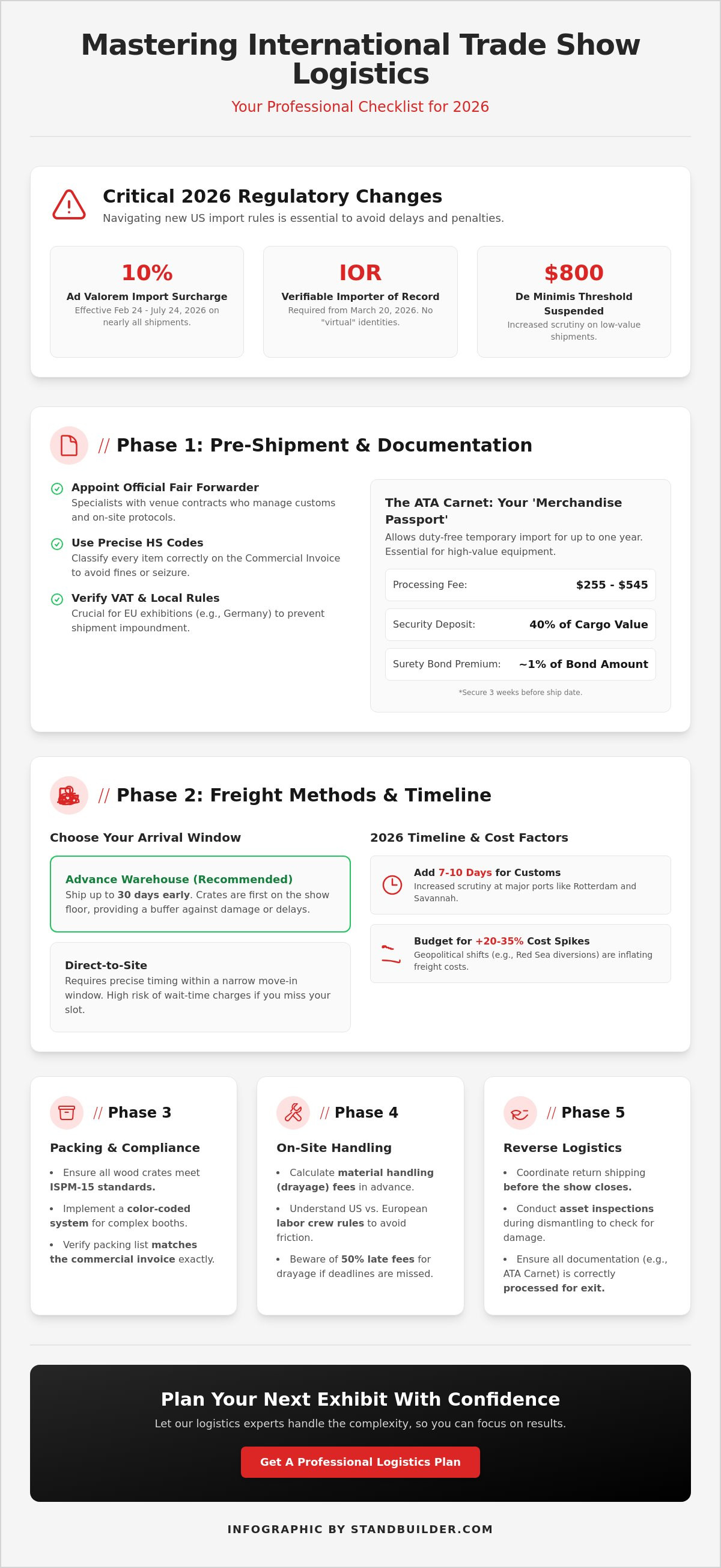
Between February 24 and July 24, 2026, a 10% ad valorem import surcharge is hitting almost every trade show shipment entering the United States. This sudden cost spike, combined with the March 20, 2026, requirement for a verifiable Importer of Record (IOR), means your standard shipping routine is now a high-stakes compliance hurdle. If you're worried about your modular booth getting stuck in customs or facing unpredictable fuel surcharges, you're not alone. The recent suspension of the $800 de minimis threshold has changed the game for every global exhibitor.
We understand that the logistics of international trade shows can feel like a moving target. That's why we've developed this international trade show logistics checklist to help you secure a professional, stress-free installation process. You'll learn how to master every cross-border detail, from calculating ATA Carnet security deposits to managing on-site drayage without incurring 50% late fees. This framework provides the transparency you need to budget accurately and ensure your exhibition stand arrives on time, every time. We'll examine the specific steps required to bypass common shipping delays and align your logistics plan with local venue labor rules.
Key Takeaways
- Master the documentation required for duty-free temporary imports by securing an ATA Carnet and using precise HS codes for every component.
- Optimize your arrival window by strategically choosing between 'Advance Warehouse' and 'Direct-to-Site' shipping to bypass port congestion and strict venue deadlines.
- Follow our professional international trade show logistics checklist to verify that all shipping crates meet ISPM-15 standards while implementing a color-coded system for complex booth setups.
- Reduce on-site friction by calculating material handling fees in advance and understanding the specific operational differences between European and American labor crews.
- Protect your long-term investment by coordinating reverse logistics and asset inspections before the show floor closes.
Phase 1: Pre-Shipment Compliance and Global Documentation
Logistics success begins months before your crates reach the pier. Your first priority on any international trade show logistics checklist is appointing an 'Official Fair Forwarder.' Unlike general freight companies, these specialists hold exclusive contracts with venues and understand the specific marshalling yard protocols for major events. They act as your primary liaison for customs clearance and on-site delivery. While you're understanding trade shows and their complex operational needs, your forwarder is managing the minute details of host country compliance.
For exhibitions in Germany or the UAE, you must verify local VAT registration requirements immediately. In the European Union, failure to register correctly can lead to your shipment being impounded at the border. Since March 20, 2026, U.S. Customs and Border Protection also requires a verifiable Importer of Record (IOR) for all declarations; shared or "virtual" identities are no longer permitted. This makes early documentation non-negotiable for a seamless entry and prevents your materials from being flagged during the current 10% ad valorem import surcharge period.
The Power of the ATA Carnet
Think of the ATA Carnet as a 'merchandise passport' for your professional equipment. It allows you to move goods across borders for up to one year without paying import duties or taxes, provided the items return to their country of origin. This is essential for high-value assets like AV equipment, prototypes, and reusable modular stand components. It simplifies the return process because the document is recognized by customs authorities in over 80 countries.
In 2026, basic processing fees range from $255 for goods valued under $10,000 to $545 for shipments exceeding $1,000,000. Most countries require a security deposit equal to 40% of the cargo value, which you can typically cover with a surety bond at a premium of about 1% of the bond amount. Securing this document three weeks before your ship date prevents last-minute panic at the terminal and ensures your custom exhibition stand isn't held for ransom by unexpected tax bills.
HS Codes and Commercial Invoices
Customs officials don't care about your marketing descriptions; they care about Harmonized System (HS) codes. These six-to-ten digit numbers classify every physical item in your shipment, from aluminum extrusions to LED tiles. If you misclassify a component, you risk heavy fines or total seizure of the booth. Precision is your best defense against delays.
The Commercial Invoice is the primary document used by customs to determine the value of imported goods. You must declare a 'fair market value' for all materials, even if they aren't for sale. Don't use 'value for customs purposes only' as a shortcut. Be precise, be honest, and ensure your packing list matches your invoice exactly. This level of detail is the only way to navigate the stricter enforcement trends of 2026 without losing your booth to a customs warehouse.
Phase 2: Selecting Freight Methods and 2026 Timeline Planning
Your choice between 'Advance Warehouse' and 'Direct-to-Site' shipping determines your booth’s survival during the move-in rush. An 'Advance Warehouse' allows you to ship materials up to 30 days before the show, ensuring your crates are the first delivered to the floor. Conversely, 'Direct-to-Site' shipping requires precise timing during a narrow move-in window. If you miss your target time, you'll face wait-time charges or forced freight redirection. Integrate this decision into your international trade show logistics checklist early to align with your custom exhibition stand design and fabrication schedule. If your stand involves complex finishes or bespoke elements, the advance warehouse offers a critical buffer against transit damage.
Don't ignore the 'dead-time' required for customs inspections at major global hubs. Ports like Rotterdam and Savannah are experiencing increased scrutiny in 2026, often adding 7 to 10 days to standard transit times. Geopolitical shifts, including Red Sea diversions, are currently adding 20% to 35% to costs on affected routes. You should also evaluate the sustainability impact of your freight. While air freight is 4 to 5 times faster, ocean freight remains the primary choice for heavy custom exhibition stands due to its lower carbon footprint and cost efficiency. You can compare global contractor quotes to find partners who prioritize green logistics and efficient route planning.
Air vs. Ocean vs. Road Freight
Air freight is the fastest option but carries the highest price tag. In 2026, rates range from $4.50 to $8.00 per kg. It's best reserved for high-value electronics or last-minute graphic replacements. Ocean freight is the workhorse of the industry. A 40-foot container from Asia to the U.S. costs between $2,200 and $3,200 in 2026, though rates are volatile. For events within Europe, road freight is the standard. Shipping from a production hub like Ratingen to major venues in Paris or Munich is efficient, but you must still account for the ATA Carnet for international shipping if you're crossing non-EU borders like the UK or Switzerland.
The 2026 Logistics Master Calendar
- 12 Weeks Out: Finalize your freight forwarding contract. Provide accurate volume and weight estimates to avoid surprise surcharges later.
- 8 Weeks Out: Dispatch ocean freight for all international destinations. This accounts for the 40% to 60% increase in transit volatility seen since the start of the year.
- 4 Weeks Out: Finalize all technical orders with the venue. This includes electricity, water, and rigging. Missing these deadlines often results in a 30% price hike.
Planning for these phases prevents the "peak season" surcharges common between June and October, which can increase rates by 25% to 40%. By locking in your logistics strategy three months in advance, you move from a state of uncertainty to a state of decisive execution.
Phase 3: Packing, Compliance, and Risk Management
Physical preparation is the stage where abstract planning meets tangible execution. Your international trade show logistics checklist must now focus on protecting your assets against the rigors of global transit and strict border biosecurity. With an estimated $22.6 billion lost annually to cargo theft, risk management isn't an optional add-on; it's a core operational requirement. Secure 'All-Risk' marine cargo insurance, which typically costs between 0.1% and 2.5% of your cargo's total insured value in 2026. This coverage should extend from the moment your crates leave the warehouse until they are safely returned to your facility.
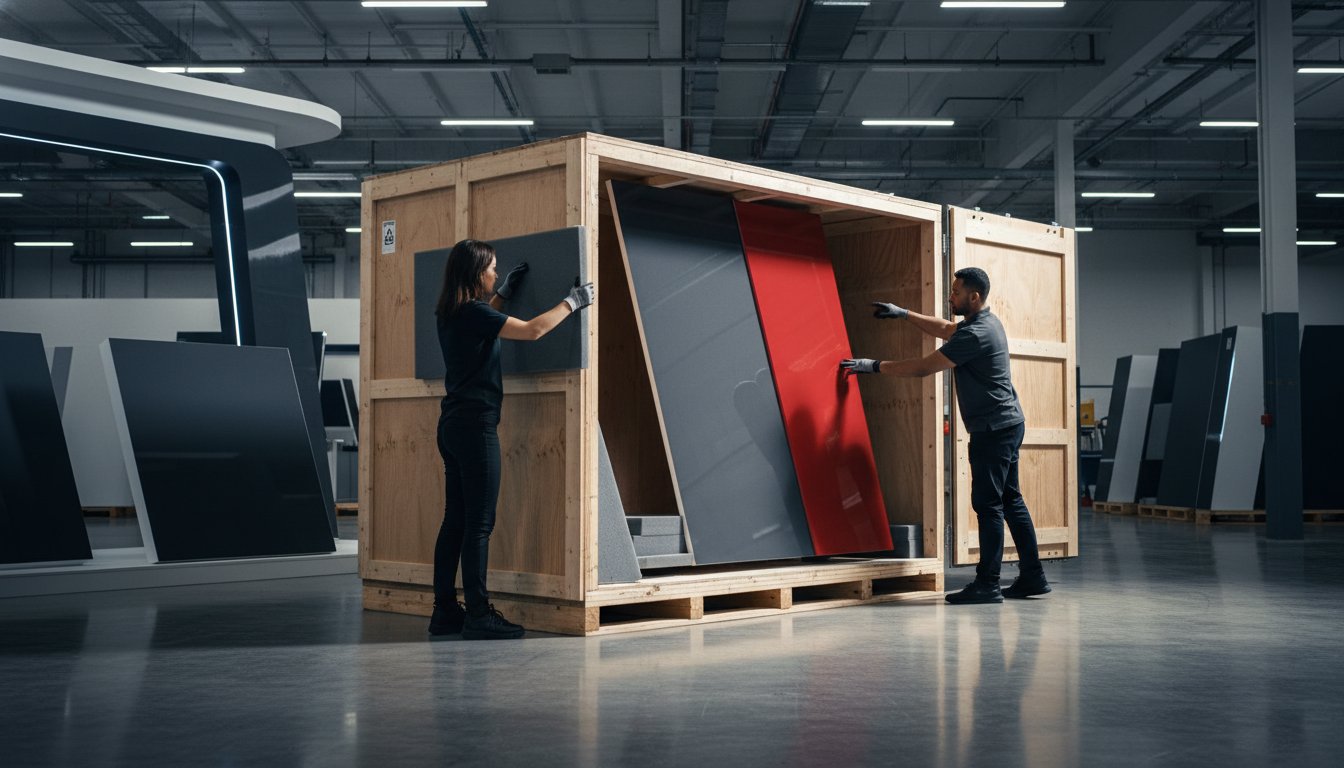
ISPM-15 is the international standard for wood packaging materials to prevent the spread of pests. For exhibitors using bespoke stands constructed with timber, compliance is a 'pass or fail' scenario. Customs officials in the U.S. and EU will immediately deport or incinerate non-compliant shipments. Always verify the 'Wheat Stamp' is clearly visible on every pallet, crate, and dunnage piece. If you're using modular stand systems made of aluminum or composite materials, you often bypass these specific timber regulations, simplifying your cross-border journey. This international trade show logistics guide provides further depth on managing these technical biosecurity hurdles.
ISPM-15 Compliance for Bespoke Stands
Non-compliant wood is one of the leading causes of shipment rejection at international borders. If your crates lack the proper heat-treatment certification, your entire booth could be turned away, regardless of your show dates. Ensure your fabrication partner provides documentation for every piece of timber used in transport. While bespoke wooden crates offer superior protection, they require this extra layer of scrutiny that modular systems typically avoid. Check your crates for the required IPPC logo and the two-letter country code to ensure they meet 2026 global standards.
Strategic Packing for Rapid Installation
Efficiency on the show floor starts inside the crate. Implement a color-coded labeling system to help local labor identify which crates belong to specific booth zones or halls. Pack your materials in reverse order of assembly. Items needed first, such as floor coverings or structural frames, should be the last ones loaded and the first ones out. This "last-in, first-out" (LIFO) method prevents your team from digging through crates while on-site clock hours are ticking away.
Don't forget to create an 'Emergency Kit' containing spare trade show backdrops, touch-up paint, and universal hardware. Including a detailed manifest inside every crate allows for rapid inventory checks and simplifies the process if customs officials decide to conduct a physical inspection. These small steps prevent minor transit damage from becoming a show-stopping disaster.
Phase 4: On-Site Handling and Technical Supervision
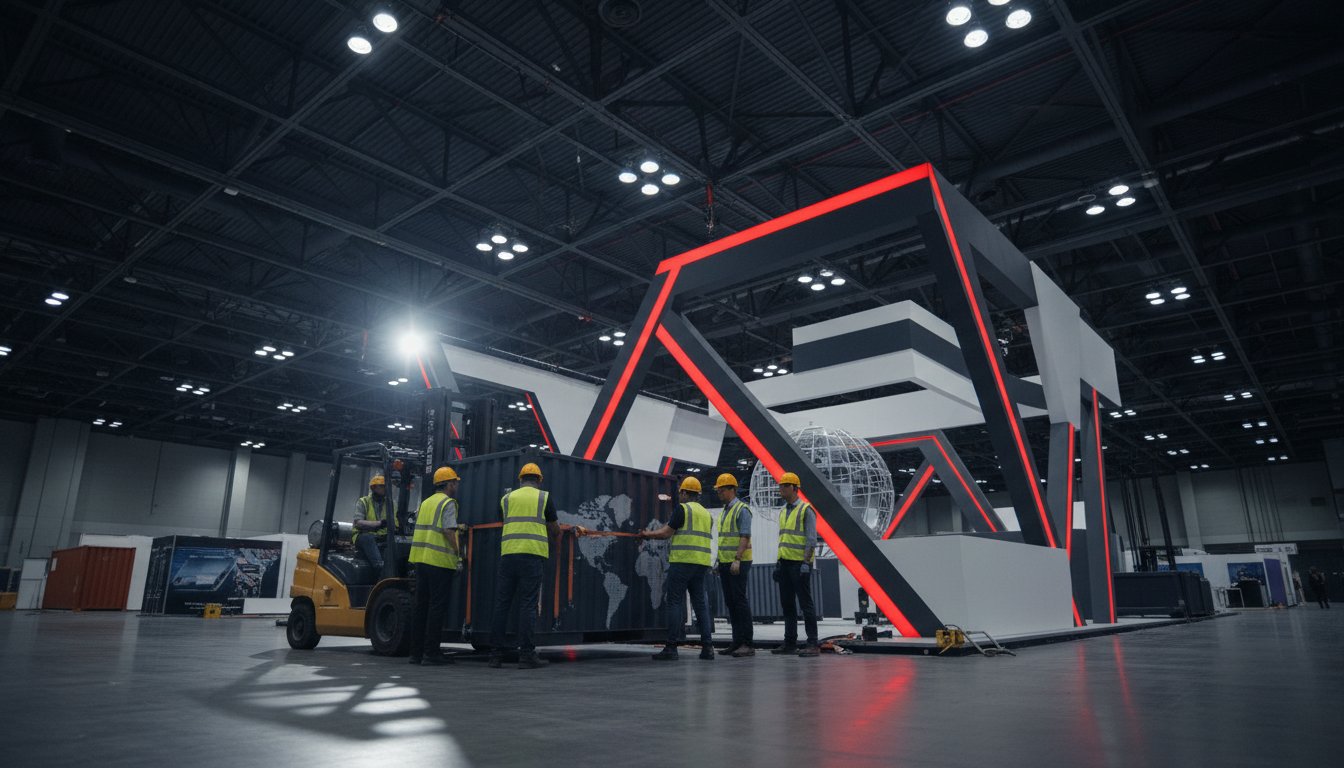
Once your freight hits the dock, your international trade show logistics checklist moves into its most expensive phase: on-site handling. In the United States, you'll encounter 'drayage,' a term that often confuses first-time exhibitors from Europe or Asia. This service covers the movement of your materials from the loading dock to your booth space, the storage of empty crates during the event, and their return for move-out. These fees are calculated per 100 pounds (CWT), typically with a 200-pound minimum per shipment. If you miss the 'advance warehouse' deadline, expect your drayage rates to spike by 30% to 50% immediately.
Navigating labor rules requires understanding deep-seated regional differences. In Germany, you'll typically hire a Messebauer, a full-service contractor who manages the entire build process from design to structural completion. In contrast, U.S. venues operate under a General Service Contractor (GSC) system, often mandating the use of unionized Installation & Dismantle (I&D) crews. Managing these local teams requires a technical supervisor who understands both sets of rules. To simplify this complex coordination, you can request five free quotes from our network of vetted international contractors who specialize in these specific regional protocols.
Understanding Drayage and Forklift Fees
Consolidating your shipment into fewer, larger crates is the most effective way to minimize material handling costs. General contractors charge significantly higher rates for 'uncrated' or 'special handling' items that can't be moved easily with a standard forklift. Always check your exhibitor manual for the 'target date' assigned to your booth. Arriving outside this window results in overtime labor charges and wait-time fees that can double your installation budget in a matter of hours. Technical compliance is equally rigid; ensure all materials meet local fire safety and structural regulations to avoid on-site red-tagging by the fire marshal.
The Role of the Technical Supervisor
A bilingual technical supervisor acts as your essential bridge between the design office and the venue floor. They ensure that your trade show backdrops are tensioned correctly and that all AV integration meets local electrical codes. For instance, many U.S. convention centers require specific fire-retardant certificates for all fabric elements, a detail often overlooked by international teams. By leveraging the Atlanta-Ratingen axis, which connects U.S. project management with European production standards, you ensure your project meets rigorous structural regulations in any city worldwide. This oversight prevents costly field modifications and ensures a professional, stress-free installation process.
Phase 5: Reverse Logistics and Asset Management
The final stage of your international trade show logistics checklist begins while the show is still active. Reverse logistics is frequently treated as an afterthought, yet it represents a significant portion of your total landed cost. To avoid the 25% to 40% peak season surcharges common between June and October, you must pre-book your 'Return-to-Origin' or 'Forward-to-Next-Show' freight at least 14 days before the event ends. Waiting until the final day of the show to arrange transport often results in limited carrier availability and forced "expedited" rates that can triple your return budget.
Before your team leaves the venue, conduct a thorough inspection of all stand components. Document any transit or on-site damage with high-resolution photos before re-crating. This evidence is vital for any insurance claims, which must typically be filed within 30 days of the incident. Once the show concludes, perform a post-show logistics ROI audit. Compare your initial budget against actual spend, including drayage and fuel surcharges, to identify cost-saving opportunities for your 2027 calendar. This data-driven approach transforms logistics from a sunk cost into a manageable strategic asset.
Storage vs. Shipping: The Cost Analysis
Deciding whether to ship your booth back to your home base or store it locally depends on your upcoming event schedule. If you plan to exhibit in Europe twice within a 12-month period, securing long-term warehousing in a strategic hub like Ratingen is often 30% more cost-effective than paying for two-way ocean freight. Conversely, for US-based shows, Atlanta serves as a primary logistics node with excellent proximity to major East Coast venues. Climate-controlled warehousing is essential for high-end bespoke materials and sensitive AV equipment to prevent warping or moisture damage during the off-season. For modular components used across multiple global regions, maintain a centralized digital inventory to track asset location and condition in real-time.
The 'Outbound' Checklist for Dismantle
Efficiency during the dismantle phase is just as critical as the build. Follow these steps to ensure a smooth exit:
- Label Empty Crates: Apply "Empty" labels to your crates immediately upon arrival at the venue. This ensures they are among the first returned to your booth space once the show floor closes.
- Finalize the Bill of Lading (BOL): Never leave the floor without a signed copy of the BOL from the official contractor. This document is your proof that the freight was handed over in good condition.
- Verify ATA Carnet Status: Ensure the customs officer stamps the 're-exportation' counterfoil correctly. Failure to secure this stamp can lead to tax penalties equal to 40% of the cargo value, even if the goods have technically left the country.
By closing the loop on your logistics plan with the same precision used during move-in, you protect your investment and prepare your team for future success. If you need assistance coordinating these complex movements, request a quote from our network to find a partner who understands the nuances of global asset management.
Secure Your Global Exhibition Success in 2026
Achieving a seamless floor presence in 2026 requires moving beyond simple shipping and into the realm of total cross-border compliance. This international trade show logistics checklist serves as your professional framework for navigating the stricter enforcement trends and volatile freight markets that define the current exhibition landscape. By integrating these steps into your early planning, you transform logistics from a source of anxiety into a competitive advantage that guarantees your booth is ready when the doors open. Mastery of these details ensures your brand remains the focus, not your shipping paperwork.
Standbuilder International simplifies this complex process through our strategic partnership with CBS Neospace GmbH. Our dual headquarters in Atlanta, USA, and Ratingen, Germany, allow us to navigate both the US GSC system and the European Messebauer model with expert precision. We help you manage every detail, from ISPM-15 compliance to on-site technical supervision. Request five free quotes for your next international exhibition stand to leverage our global network and secure a stress-free installation. Your next show floor victory starts with a decision made today. Let's make your 2026 tour effortless and professional.
Frequently Asked Questions
What is an ATA Carnet and do I need one for international trade shows?
An ATA Carnet acts as a merchandise passport that allows for the duty-free and tax-free temporary import of goods for up to one year. You definitely need one for high-value exhibition equipment like AV sets or prototypes if you're crossing borders outside of free-trade zones. Without it, you'll be forced to pay a temporary import bond, which is typically double the value of the goods, causing significant cash flow strain during your event.
How early should I start planning my international trade show logistics?
Start your planning at least 12 weeks before the show opens to secure favorable freight rates and avoid peak season surcharges. This lead time is essential because 2026 shipping routes are currently experiencing 35% volatility due to geopolitical diversions in the Red Sea. Early planning allows you to finalize your international trade show logistics checklist and lock in an Official Fair Forwarder before the 30% late-order price hikes hit.
What are ISPM-15 standards and why do they matter for my booth?
ISPM-15 standards require that all wood packaging material thicker than 6mm be heat-treated and stamped with the IPPC mark to prevent the spread of pests. These regulations matter because customs agents in the US and EU have increased physical inspections by 20% in 2026. Any crate found without the official stamp is subject to immediate incineration at the exhibitor's expense, which can result in the total loss of your booth materials before the show begins.
How is drayage calculated at international exhibition venues?
Drayage is calculated based on the weight of your shipment rounded up to the nearest 100 pounds (CWT). Most venues impose a 200-pound minimum charge per individual shipment, so shipping multiple small boxes separately is significantly more expensive than one large crate. In 2026, many US venues also apply a 30% surcharge for "special handling" of items that aren't crated or easily moved by standard forklifts, making professional packing even more critical.
Can I use my own domestic courier for international booth shipping?
Using a standard domestic courier for a large exhibition booth is generally discouraged because they lack the "target date" access required by major venues. While a courier might get your box to the city, they won't manage the marshalling yard queue or the move from the dock to your booth space. Specialized fair forwarders are the only partners who can guarantee delivery directly to your stand during the narrow move-in window provided by the organizer.
What happens if my exhibition materials are delayed at customs?
If materials are delayed, your freight forwarder must immediately file a request for expedited release or a secondary inspection if the delay is due to documentation errors. Having a digital copy of your ATA Carnet and HS codes ready can resolve 85% of documentation-related holds within 24 hours. If the delay is permanent, your only option is to source furniture and AV rental locally from a vetted contractor network to ensure you have a presence on the show floor.
Is it better to ship my stand or rent a booth locally in Europe?
Renting a modular stand or country pavilion locally is often better if your event is a one-off or if shipping costs exceed 50% of the booth's value. However, for brands requiring a high-end bespoke presence, shipping a custom stand and storing it in a hub like Ratingen for future shows is more cost-effective over a three-year cycle. This strategy avoids the 2026 fuel surcharges that are currently inflating international shipping rates by 25% on average.
How do I recover VAT on my international exhibition expenses?
You can recover Value Added Tax (VAT) by filing a refund claim under the EU's 13th Directive for non-EU businesses. This process requires you to submit original invoices and proof of your business status in your home country to the host nation's tax authority. Because the recovery process can take 6 to 12 months, many exhibitors hire a specialized tax recovery agent to manage the filing and ensure all 2026 compliance rules are met without error.